
EVO33 Deposits & Withdrawals
How e-wallet and bank deposits and withdrawals work in Nepal, why a withdrawal gets held, and the payment safety rules that protect your money.
Written for players in Nepal · Last updated 21 August 2026
In short
Deposits are usually near-immediate because e-wallet transfers settle directly. Withdrawals take longer because they pass through checks first — identity verification, any outstanding wagering, and confirmation that the receiving account belongs to you. A pending withdrawal is normally a check in progress, not a refusal.
18+ only. Gambling involves financial risk — never stake more than you can afford to lose. See our responsible gambling page. Affiliate disclosure: this is an independent information site, not the operator. We may earn a commission from links here.
What this page covers
Everything below is written for players in Nepal
Why do deposits arrive faster than withdrawals?
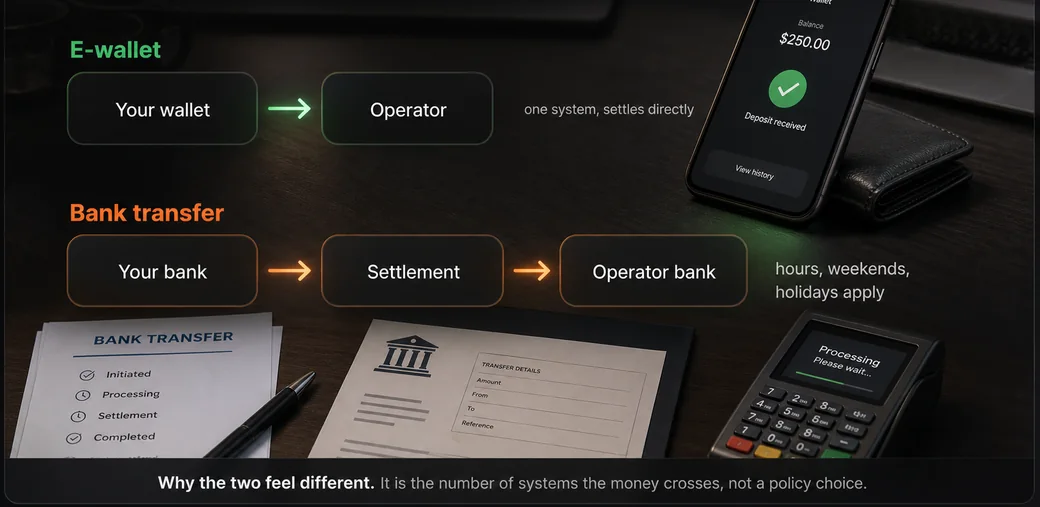
It is not a policy choice so much as a difference in mechanism, plus a difference in what has to be verified.
| Route | How it works | What affects the timing |
|---|---|---|
| E-wallet | You authorise a transfer inside the wallet app. The wallet confirms it immediately and the balance moves between accounts already held on the same system. | Very little on the way in. On the way out, the operator’s checks, not the wallet’s. |
| Bank transfer | The instruction is passed between two banks and settled through the banking system. | Banking hours, weekends, public holidays, and each bank’s own processing cycle. |
The asymmetry has a second cause. Money coming in needs no verification — nobody is defrauded by a deposit. Money going out has to be checked against anti-money-laundering obligations and against the account’s own history, which is a legal requirement for the operator rather than an obstacle they invented.
What should I expect when depositing?
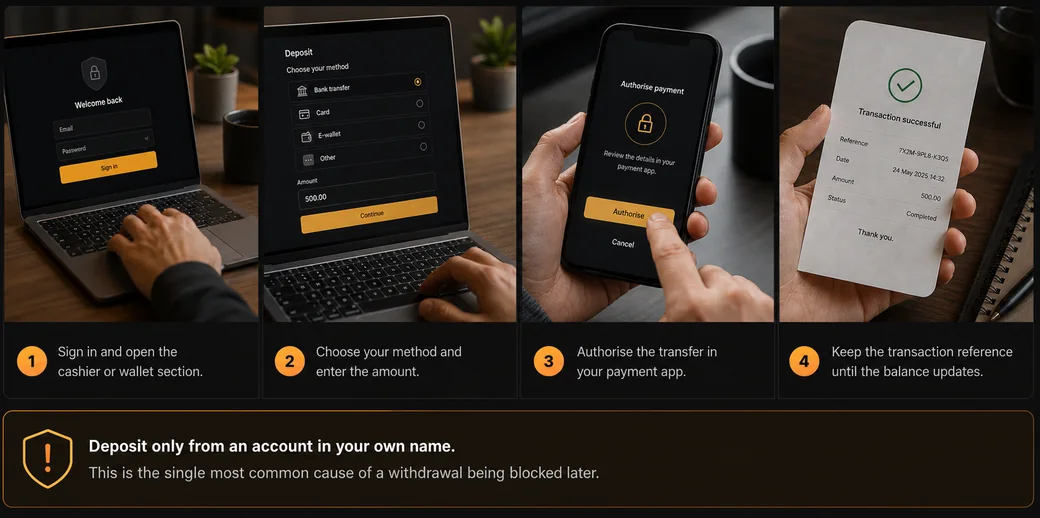
- Sign in — see our login guide if you cannot get in — and open the cashier or wallet section.
- Choose your method and enter the amount. The current limits and any fee are shown to you at this point — always read that screen rather than relying on any figure published elsewhere, including here.
- Authorise the transfer in your payment app.
- Keep the transaction reference until the balance updates.
Deposit only from an account in your own name. This is the single most common cause of a withdrawal being blocked later. Using a friend’s or relative’s wallet creates a name mismatch that the payout check will catch, and at that point the money is already in the account and difficult to move.
Why is my withdrawal pending?
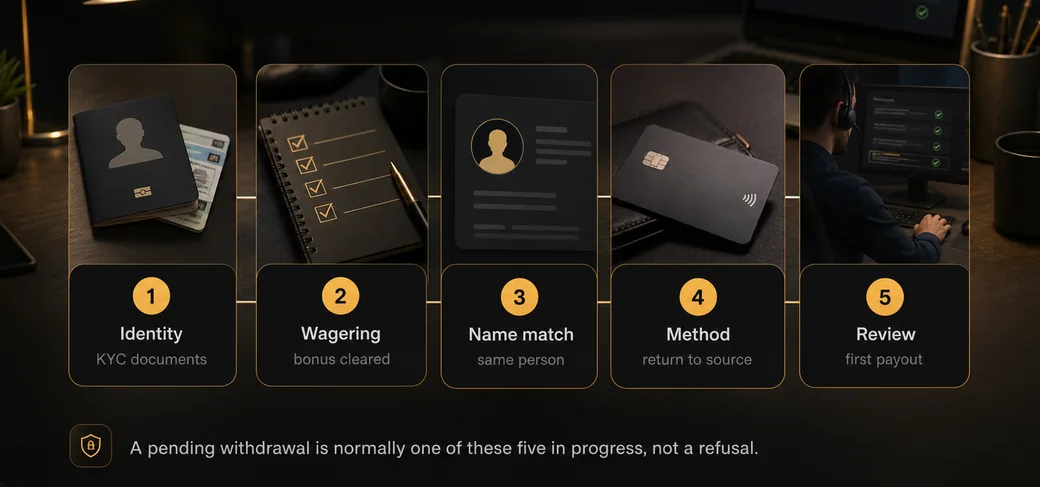
Almost always one of five reasons. None of them mean the money is gone.
| Reason | What to do |
|---|---|
| Identity verification (KYC) is incomplete | Upload the documents requested — usually photo ID and sometimes proof of address. Make sure the name matches your payment account exactly. |
| Wagering is not finished | If a bonus is active, funds stay locked until the requirement is met. See our bonus guide for how to calculate what remains. |
| Name mismatch | The receiving account must be in your name. If you deposited from someone else’s wallet, contact support before requesting more. |
| Return-to-source rules | Many operators return funds by the method used to deposit, at least up to the deposited amount. Withdrawing to a different method can be declined for this reason alone. |
| First withdrawal review | A first payout is commonly checked more carefully than later ones. Subsequent withdrawals from a verified account usually move more quickly. |
What genuinely helps: complete verification before you need it rather than when a payout is waiting, keep the name consistent across account and wallet, and raise a support ticket with your transaction reference rather than submitting repeat withdrawal requests, which can push a transaction back into the queue.
Someone has offered to release my withdrawal — is that real?
No. A pending withdrawal is exactly when fraud finds people, because they are anxious and looking for help in public places. Four patterns to recognise:
- A “release fee”, “tax”, “clearance charge” or “unlock payment”. You are never required to send money in order to receive your own money. This is the most common version and it is always a scam.
- Accounts on Telegram, Facebook, WhatsApp or TikTok presenting as official support. Anyone who contacts you first, or who you find through a comment section, should be assumed to be neither the operator nor helpful. Use only the contact route inside your account.
- A request for your password or a one-time code. No legitimate support process needs either. An OTP handed over is being used against your account while you speak.
- A request to install screen-sharing or remote-access software. This hands over your device, your wallet and your banking app together.

What payment habits protect me?
- Deposit and withdraw only using accounts in your own name.
- Never share a one-time code or password with anyone, for any reason.
- Keep the transaction reference until the balance updates, and screenshot the confirmation.
- Complete verification early, while nothing is waiting on it.
- Read the limits and fees shown on the cashier screen at the moment of the transaction — those are the only current figures.
Frequently asked questions
Why is my withdrawal still pending?
Usually incomplete identity verification, unfinished wagering on an active bonus, a name mismatch between your account and payment method, or a first-payout review. Check which applies before resubmitting — repeat requests can return the transaction to the back of the queue. If you are unsure whether you have met EVO33’s play-through and bonus turnover rules, our guide to EVO33 withdrawal rules and Nepal’s betting law lists each one with its clause.
Can I withdraw to a different account?
Often not. Operators commonly return funds to the method used for depositing, at least up to the amount deposited, and the receiving account must be in your own name. Check the cashier rules before requesting a payout to a new method.
What is KYC and why do I have to do it?
Know Your Customer — the identity verification operators are legally obliged to perform before paying out. It normally means photo ID and sometimes proof of address. Completing it before you request a withdrawal is the single most effective way to avoid delay.
Are there fees?
That depends on the method and the amount, and the figures change. The cashier screen shows the current fee before you confirm the transaction — treat that as the only reliable source, rather than any figure published on a third-party site including this one.
Someone offered to release my withdrawal for a fee — is that real?
No. You are never required to pay anything to receive your own money, and no genuine support agent will contact you first on social media. Stop, do not send anything, and raise a ticket through the contact route inside your own account. Our help guide explains how to tell genuine support from an impersonator.
This is an independent information site. We do not host any download, cannot access your account, and never ask for a password or a one-time code.
Move money safely
Deposits settle quickly; payouts pass checks first. Knowing which is which removes the panic.